Adrian Kavanagh, 25 May 2026
Bye-election contests are usually bad news for government parties, especially if these occur in the middle of the electoral cycle. Between 1982 and this weekend’s elections, government parties had won by-election contests on only three occasions (out of 33 contests) and two of those contests involved family members retaining the party (Fine Gael) seat in contests where there was an obvious sympathy vote at play (Meath East 2013, Longford-West 2014). The only government “pick-up” came when Labour won the 2011 Dublin West bye-election, helped no doubt by this election taking place on the same day that Michael D. Higgins won the presidential election and taking place before the 2011 Budget, after which point the Labour vote started to go into freefall.
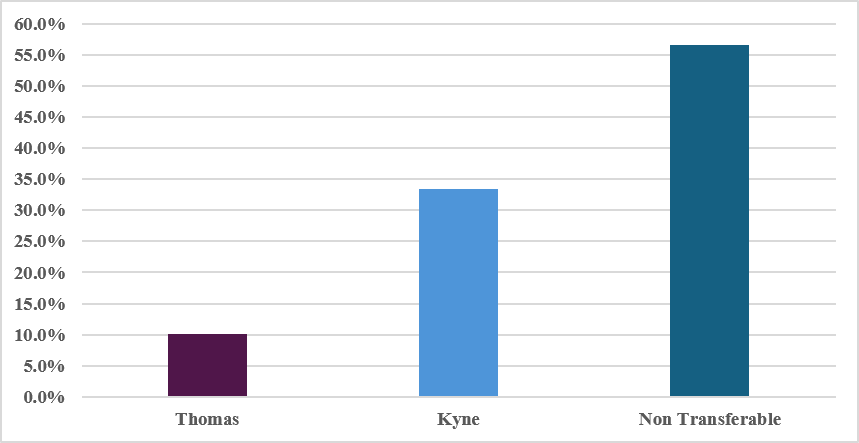
However, Fine Gael won the Galway West bye-election this weekend, with voter transfers helping former Dáil deputy, Senator Seán Kyne, to overtake Independent Ireland’s Cllr. Noel Thomas on the final count, with Kyne taking a large chunk of the vote transfers from the third placed candidate, Labour’s Cllr. Helen Obgu (see below).
The Fine Gael result in Dublin Central was not as good, but probably it’s fair to say that it was far from disastrous. The party share of the vote was down a few percentage points, but Cllr. Ray McAdam did well enough to suggest that he will be in contention to regain a seat for Fine Gael in Dublin Central at the next general election (especially if this constituency gains another seat in the next Electoral Commission revision of Dáil constituency boundaries in 2027-28. For McAdam and other losing by-election candidates, it is worth noting that, in relation to the thirty six bye-election contests were held in the Republic of Ireland between 1980 and 2021, thirty nine candidates, who failed to win seats in these contests, went on to win a seat in the following Dáil general election contest. (And one in four of the successful by-election candidates either failed to win a seat in the following Dáil general election contest or failed to defend that seat.)
In all, the combined government party vote share (28.9%) in Galway West by-election fell by 6.8% relative to the combined Fianna Fáil/Fine Gael support level in that constituency at General Election 2024 (35.6%) and the combined government party vote share in Dublin Central fell by 9.0% relative to General Election 2024. While not marking especially good news for the government parties, the level of decline in the combined government party support levels was a good bit lower than the average for the (percentage) loss of government party support at by election contests over the last four and a half decades. Between 1980 and 2021 government party candidates had won, on average, a combined vote share of 30.7% at by-election contests, having won, on average, a combined vote share of 46.1% in the same constituencies in the previous general election contests.
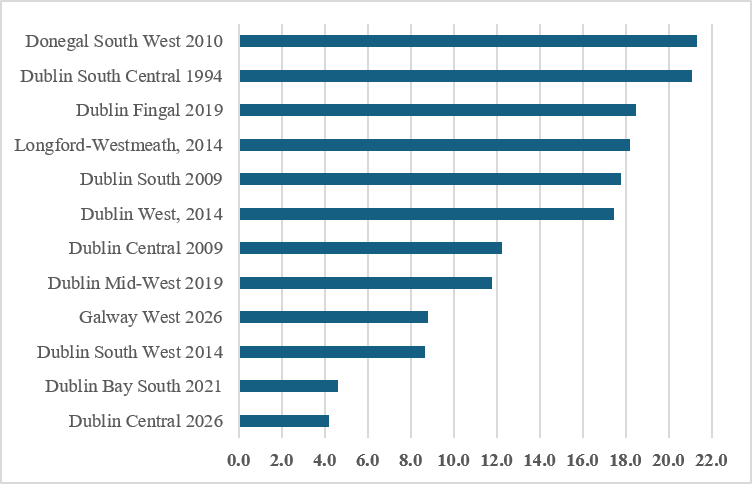
It was, however, a bad day for the other government partner, Fianna Fáil. They won their lowest ever vote share in a Dáil by-election in Dublin Central (see Figure 3), while Galway West represented their fourth lowest vote share in a by-election contest (and their lowest ever vote share in a constituency located outside the Dublin region).
It was a very good day for the Centre Left parties. The Social Democrats won in Dublin Central, with Cllr. Daniel Ennis topping the poll and extending his lead over Sinn Féin’s Janice Boylan over the remaining counts, but it was also a good contest for Green Party, with Cllr. Janet Horner finishing in third place with 11.7% of the first preference votes, establishing her as a serious contender to regain the Green Party seat in Dublin Central (which the party lost in 2024) at the next general election. In Galway West Cllr. Helen Ogbu of the Labour Party polled well, especially in Galway City, and finished in third place, but it was also a good election for the Social Democrats’ first-time candidate, Míde Nic Fhionnlaoich, who remained in the contest until Count 9 (out of 11 counts).
Sinn Féin did not have a good day, however. Cllr. Janice Boylan did finish in second place in their party leader’s home constituency, but was well behind Ennis on the final count in Dublin Central, with Ennis finishing on 12,050 votes and Boylan finishing on 7,787 votes. In Galway West, Sinn Féin were never even close to being in contention, as their candidate, Mark Lohan, finished in seventh place with just 6.7% of the first preference votes.
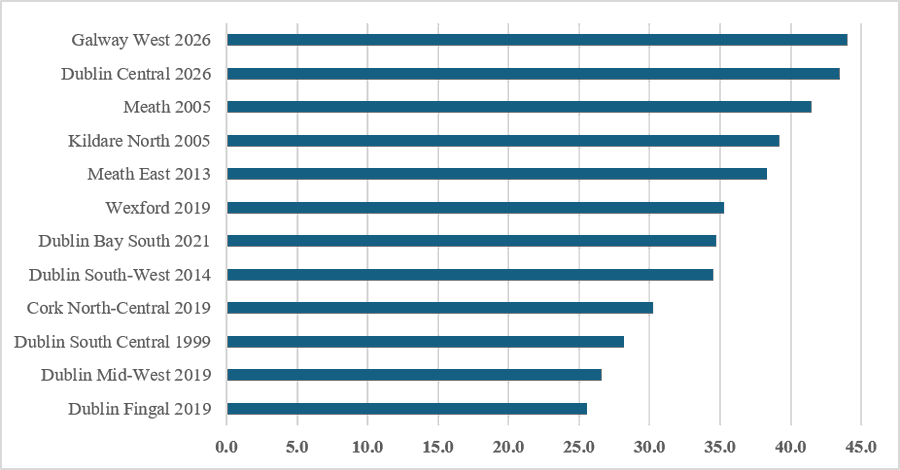
Voter turnout levels are usually notably lower in bye-election contests than they are at general elections and there have been some exceptionally low turnouts registered for some bye-election contests, most notably the 1999 Dublin South-Central contest (which I studied in detail for my PhD thesis) and the bye-election contests held in November 2019 (which were artificially low, in fairness, as most people expected a general election to be taking place within months of these contests, as indeed turned out to be the case). As it transpired, turnout levels in these contests were relatively OK for by-election contests. The turnout rate for the Dublin Central bye-election was a healthy (for a Dublin bye-election) 43.5%, down by less than ten percent on the 52.3% turnout level in that constituency in the 2024 General Election, and this marked the highest turnout level for a Dublin by-election since the 2014 Dublin West contest. The voter turnout level for the Galway West bye-election (44.0%) was the lowest turnout level for a by-election in the Connacht-Ulster region in the period since 1980 (and probably lowest ever by-election turnout level in the region historically). The turnout level in Galway West was 58.5% in the 2024 General Election, so turnout was 14.5% lower in this by-election contest. As noted above, it is not unusual to see a lower turnout in a bye-election contest. The vote shares for candidates (with the rural-based Thomas and Kyne faring very well) suggests that turnout may have dropped to a greater extent in Galway City than in the more rural parts of Galway West.