As you were more or less…: Constituency-level analysis of the Sunday Business Post-Red C opinion poll (13th March 2016)

Adrian Kavanagh, 12th March 2016

The counting for the February 2016 General Election has concluded and new Dail has just sat for the first time (on Thursday), but we already have our first post-general election opinion poll. Yesterday’s Sunday Business Post-Red C opinion poll estimates party support levels as follows: Independents and Others 29% – including Social Democrats 5%, Anti-Austerity Alliance-People Before Profit 4%, Renua 2%, Green Party 3%, Independent Alliance 5%, Other Independents 9%, Fine Gael 27%, Fianna Fail 25%, Sinn Fein 15%, Labour Party 4%. As such, there is no major movement in party/grouping  support levels since the February 26th election, with the notable exceptions of the Social Democrats (up 2%) and Labour (down 3%). My constituency-level analysis of these poll figures estimates that party seat levels, should such national support trends be replicated in an actual general election, would be as follows: Fianna Fail 47, Fine Gael 53, Sinn Fein 25, Labour Party 0, Anti Austerity Alliance-People Before Profit 5, Social Democrats 4, Green Party 2, Independents 22. 

(Update: Following the prolonged period of government formation, there was a gap of exactly two months until the next Red C opinion poll was published. This did not point to any significant movement in the numbers, with no change in the Fine Gael and Fianna Fail support levels, but this poll did show the Independents losing some ground to Sinn Fein and some of the smaller parties/groupings. The May 13th Paddy Power-Red C opinion poll estimates party support levels as follows: Independents and Others 29% – including Social Democrats 4%, Anti-Austerity Alliance-People Before Profit 6%, Renua 1%, Green Party 4%, Independent Alliance 3%, Other Independents 9%, Fine Gael 27%, Fianna Fail 25%, Sinn Fein 16%, Labour Party 5%. My constituency-level analysis of these poll figures estimates that party seat levels, should such national support trends be replicated in an actual general election, would be as follows: Fianna Fail 48, Fine Gael 52, Sinn Fein 25, Labour Party 2, Anti Austerity Alliance-People Before Profit 8, Social Democrats 4, Green Party 2, Independents 18. Note that the remainder of the discussion/analysis in this post relates solely to the March 13th opinion poll.)

Continue reading

Posted in opinion polls | Tagged | 1 Comment

Seanad Elections April 2016: Votes Controlled By Parties/Groupings

Adrian Kavanagh, 8th March 2015

Figure 1: Seanad 2016 Vocational Panels - Votes controlled by different political parties/groupings

Figure 1: Seanad 2016 Vocational Panels – Votes controlled by different political parties/groupings

Elections to the five different Seanad vocational panels (as well as for the Trinity and National University of Ireland constituencies) for the 25th Seanad will take place over the coming months. While there are obvious restrictions in terms of the electorates for the Trinity and NUI constituencies, the electorates for the five vocational are solely comprised of elected politicians, namely

  • 949 City and County Councillors (councillors elected in 2014, or co-options between 2014 and 2016)
  • 158 Dail Deputies (those elected in February’s general election)
  • 53 Senators (elected at the 2011 Seanad election, or elected at Seanad by-elections between 2011 and 2015 – excluding the 7 Senators who won seats in February’s general election)

Assuming that co-options are in place to replace the 49 City and County Councillors who won seats at the February General Election (as well as Cllr. Willie Kennedy – ar dheis Dé go raibh a anam and Cllr. Dan Joe Fitzgerald – ar dheis Dé go raibh a anam), this means that the total size of the electorate for the Seanad vocational panel elections will be 1,160. If one was to assume that every one out of these 1,160 TDs, Senators and Councillors vote in these elections, this figure would translate into quotas of around: Continue reading

Posted in Seanad election | Tagged | 5 Comments

Final Seat levels at February 2016 General Election – An Overview

Adrian Kavanagh, 3rd March 2016

With the Longford-Westmeath “long count” about to conclude this morning with the election of Fine Gael’s Peter Burke and Labour’s Willie Penrose, the final overall seat tallies can be confirmed as follows:

  • Fine Gael 50
  • Fianna Fail 44
  • Sinn Fein 23
  • Independents 23 (including Independent Alliance 6 and Independents4Change 4)
  • Labour Party 7
  • Anti Austerity Alliance-People Before Profit 6
  • Social Democrats 3
  • Green Party 2

Underneath these figures lie some interesting regional/geographical variations in terms of where parties/groups won seats and where they made gains/losses relative to 2011. Continue reading

Posted in Uncategorized | Leave a comment

How did the Younger Ones (candidates aged between 21 and 35) fare at General Election 2016

Adrian Kavanagh, 1st March 2016

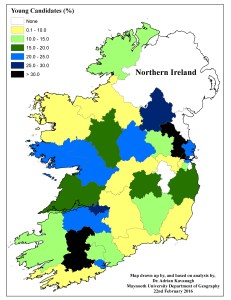
Figure 1: Percentage of younger candidates (aged between 21-35) by Dail constituency (2016 General Election)

Figure 1: Percentage of younger candidates (aged between 21-35) by Dail constituency (2016 General Election)

In an earlier post, I listed all eighty four candidates in the 21-35 age category (15.2% of the total number of General Election candidates) who contested Friday’s general election contest. This post reviews how these candidates fared in the election and finds that only 13 (15.1% of the younger candidates’ grouping) went on to win seats in the election. This contrasts starkly with the trends observed at the 2011, as discussed in an earlier post. In this election, twice as many younger candidates proved to be ultimately successful – 27 younger candidates, amounting to 39.7% of the younger candidates contesting that election. There is no sense that the expected boost in youth turnouts, following on the strong mobilisation of younger voters at the 2015 Marriage Equality Referendum, acted to improve the electoral prospects of younger candidates in the February 2016 election. Continue reading

Posted in Candidates, General Election, Young candidates | Tagged , , | Leave a comment

Tally Ho! Which local newspapers have published General Election 2016 tally figures?

Adrian Kavanagh, 1st March 2016

As an electoral geographer, I am very interested in outlining which local newspapers published tally figures for February’s general election contest. When I refer to tallies/tally sheets I am of course NOT referring to election results or election count details, but instead referring to documents that can show the number of votes each candidate won in each polling box in a Dail/general election constituency – or part of a general election constituency. These can give a very accurate sense then as to the geography of a party/candidates’s votes within a particular constituency. Tally figures are the very lifeblood of Irish electoral geography. Continue reading

Posted in General Election, Tally figures | Tagged , , , , | 5 Comments

Female candidates at the 2016 General Election

Adrian Kavanagh, 29th February 2016.

Figure 1: Percentage support for female candidates by Dail constituency, 2016 General Election

Figure 1: Percentage support for female candidates by Dail constituency, 2016 General Election

As of this morning, counting is still continuing in a number of constituencies, but at this stage it is clear that there will be a significant increase in the number of seats won by female candidates relative to the level won in 2011, while there will also be a notable increase in the number of votes won by female candidates. At the 2011 General Election, female candidates won just 25 of the 166 Dail seats (or of the 165 Dail seats being contested). Female candidates won 332,821 first preference votes nationally, amounting to 14.8% of the national first preference votes. The low female vote levels/seat levels were, in part, due to the small number of female candidates contesting that election, with only 86 female candidates (out of a total of 566) contesting this election – 15.2% of the total.

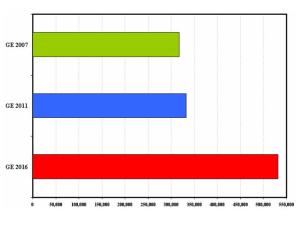
As has been well flagged already, and as discussed in detail in the 2016 General Election Candidates post, the introduction of a gender quota resulted in a significant increase in female candidate levels, with 163 female candidates contesting the election (out of a total number of 551, amounting to 29.6% of the total number of candidates).  Did this also result in an overall increase in support levels and seat levels for female candidates? Why, yes. At this stage, it looks as if 35 female candidates will win seats in this election – amounting to 22.3% of the 157 seats being actually contested over the weekend, or 22.2% of the 158 seats in the next Dail. The overall support level for female candidates also increased notably. At this stage (and this number is likely to be amended slightly following some final recounts), it can be be stated that female candidates won over half a million votes (531,800 votes) for the first time in a Irish general election – amounting to 24.9% (almost one quarter) of the first preference votes cast in this election. This amounts to an increase of almost 200,000 in the total number of first preference votes won by female candidates between the 2011 and 2016 General Elections (see Figure 2 below).

Figure 1: First preference votes won by female candidates at the 2007, 2011 and 2016 General Elections

Figure 2: First preference votes won by female candidates at the 2007, 2011 and 2016 General Elections

Female candidates fared best in the Dublin region, where they won 38.8% of all the first preference votes and 18 of the 44 seats (40.9%). Outside of Dublin, female candidates accounted for 20.4% of all the first preference votes. The notable urban-rural divide, or East-West divide, in female success levels is further underpinned by the fact that the next strongest region for female candidates was Leinster (25.3%), followed by Connacht-Ulster (23.6%) and Munster (15.2%).

As Figure 1 (above) shows, female candidates fared especially well in some constituencies, but particularly in the Dublin region. Female candidates had accounted for over half of the candidates (5 out of 9) in the Kildare South constituency. But in this election, female candidates won over half of the first preference votes in two Dublin constituencies – Dublin South-Central (59.4%) and Dun Laoghaire (57.9%). They came very close to winning half of the votes in the Dublin Central (49.3%) constituency. Outside of Dublin, the best constituency for female candidates in terms of first preference votes was Cavan-Monaghan (44.6%).


Posted in Gender, General Election | Tagged , | Leave a comment

RTE-Behaviour & Attitudes exit poll (27th February) – quick overview

Adrian Kavanagh, 26th February 2016

The RTE-Behaviour & Attitudes exit poll was published within the last few minutes

Figures are similar to last night’s exit poll, but slightly worse for the government parties. These figures suggest that support levels for both government parties have fallen by over ten percent relative to their 2011 figures. Both Fianna Fail and Sinn Fein make gains, although the extent of Sinn Fein gains may be relatively disappointing for that party given the support it enjoyed in most opinion polls across 2014 and 2015 and indeed up to the final week of the February 2016 General Election campaign. This party fare better in this exit poll however.

The extent of Fine Gael losses may actually help Labour to hold more of its seat than might have been expected in recent analyses, indeed over and above the seat estimates outlined below, as Labour candidate may now be able to benefit from Fine Gael eliminations/transfers in a number of constituencies.

Fianna Fail are likely to be competitive in most constituencies. If the swing to the party is mirrored, or even stronger, in Dublin, they may well be in contention in some constituencies that seemed to be long shots for most of the campaign, including Dublin Central. But the swing to the party may also result in massive surpluses in constituencies where the party ran just one candidate, such as Laois, Limerick or Limerick City.

My initial run of the model estimates seat levels by party/grouping, based on a constituency level analysis of the exit poll as follows:

Fine Gael 47, Independents and Others 42, Fianna Fail 37, Sinn Fein 24, Labour Party 8

  • Labour, however, on these numbers have a good chance of winning a few extra seats, mainly because the drop in Fine Gael support opens up the possibility of winning more Fine Gael transfers. On these poll numbers, Labour with a bit of luck, and if their candidates prove to be especially transfer friendly, could win 12 or 13 seats

If the fact that the Independents and Others support levels is being split across 307 candidates proves to be a significant issue here (I try to control for this, but…), or the fact that this grouping is a very wide and varied one (with transfers between candidates not likely to be as strong as intra-party transfers), the seat numbers for them may not be as large as estimated here. Against that, candidates from this grouping may well be better placed to win transfers from the political parties, whose supporters may be more willing to transfers to independents and smaller parties than to the other large parties.

My model was relatively close in relation to estimating seat levels by party/grouping on the exit poll for the 2011 election (coming within 3 seats, or less, of actual figures for all parties) . This may well not pan out this time, given the complications added by the boundary changes, as well as the growing strength (and sheer diversity within) the Independents and Others grouping.

Posted in Uncategorized | Leave a comment

Irish Times-Ipsos MRBI exit poll (26th February) – quick overview

Adrian Kavanagh, 26th February 2016

The Irish Times-Ipsos MRBI exit poll was published literally within an hour of polls closing

These figures suggest that support levels for both government parties have fallen by nearly ten percent relative to their 2011 figures. Both Fianna Fail and Sinn Fein make gains, although the extent of Sinn Fein gains may be relatively disappointing for that party given the support it enjoyed in most opinion polls across 2014 and 2015 and indeed up to the final week of the February 2016 General Election campaign.

The extent of Fine Gael losses may actually help Labour to hold more of its seat than might have been expected in recent analyses, indeed over and above the seat estimates outlined below, as Labour candidate may now be able to benefit from Fine Gael eliminations/transfers in a number of constituencies.

Fianna Fail are likely to be competitive in most constituencies. If the swing to the party is mirrored, or even stronger, in Dublin, they may well be in contention in some constituencies that seemed to be long shots for most of the campaign, including Dublin Central. But the swing to the party may also result in massive surpluses in constituencies where the party ran just one candidate, such as Laois, Limerick or Limerick City.

My initial run of the model estimates seat levels by party/grouping, based on a constituency level analysis of the exit poll as follows:

Fine Gael 47, Independents and Others 42, Fianna Fail 38, Sinn Fein 23, Labour Party 8

  • Labour, however, on these numbers have a good chance of winning a few extra seats, mainly because the drop in Fine Gael support opens up the possibility of winning more Fine Gael transfers. On these poll numbers, Labour with a bit of luck could win 12 seats
  • I accidentally allocated Fianna Fail two seats in Limerick City last night when I first ran this model, so numbers here have been amended. This indicates a potential trend in which Fianna Fail could have huge surpluses in constituencies where they have not run enough candidates.

If the fact that the Independents and Others support levels is being split across 307 candidates proves to be a significant issue here (I try to control for this, but…), or the fact that this grouping is a very wide and varied one (with transfers between candidates not likely to be as strong as intra-party transfers), the seat numbers for them may not be as large as estimated here. Against that, candidates from this grouping may well be better placed to win transfers from the political parties, whose supporters may be more willing to transfers to independents and smaller parties than to the other large parties.

My model was relatively close in relation to estimating seat levels by party/grouping on the exit poll for the 2011 election (coming within 3 seats, or less, of actual figures for all parties) . This may well not pan out this time, given the complications added by the boundary changes, as well as the growing strength (and sheer diversity within) the Independents and Others grouping.

Posted in Uncategorized | Leave a comment

Voter Turnout at the 2011 General Election: A Geographical Overview

Adrian Kavanagh, 26th February 2016

This post offers an in-depth geographical study of voter turnout levels at the last general election in 2011. The geographical variations in General Election 2011 turnout levels illustrated in this study are likely to be again, more or less, evident in today’s election.  Continue reading

Posted in Uncategorized | Leave a comment

General Election 2016 – Why your vote matters

Adrian Kavanagh, 26th February 2016

A general election to elect the new members of the 32nd Dail is taking place on Friday 26th February 2016 (TODAY!!!). The results of this election will be determined by many factors – some of which will be local, while others will be national in scope – as has been discussed in nauseating detail across different posts on this website. But voter turnout levels on Election Day will also have a major bearing on the results in different Dail constituencies, as will be discussed here. Continue reading

Posted in General Election, Voter turnout | Tagged , , | Leave a comment