Adrian Kavanagh, 15th November 2012
As someone who has been interested in the area of voter turnout since commencing PhD researches on this topic back in…gulp…1999 and as a geographer, I am always interested in attaining turnout data for very small areas/at a sub-constituency level. While constituency level turnout analysis/maps can uncover interesting trends and point towards certain factors impacting on these, there are however only a small number of these (forty-three general, or Dail, election constituencies at presenting, falling to forty following the next general election) meaning that any analyses of turnout at this level faces issues to do with small-numbers problems. It is also the case that the really interesting turnout geographies occur usually at the sub-constituency level and there can be significant variations in turnout levels within a single constituency – analyses of such geographies/trends can offer a deeper understanding of what factors are shaping/influencing turnout propensity and can add to/complement individual level studies of turnout behaviour engaged in by those in the field of political science.
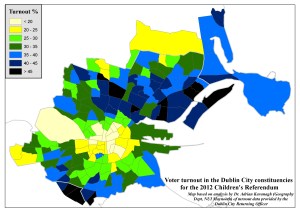
In this post I am going to look at turnout in the six Dublin City constituencies at the electoral division level for the last referendum prior to last weekend’s Children’s Referendum. This study is based on my own geographical analysis of the excellent turnout by polling box figures that the Dublin City returning officer makes available from their own website, involving the calculation of electoral division level turnout figures based on these and the mapping of these figures (as in Figure 1 below).

Figure 1: Voter turnout by electoral division (%) in the Dublin City constituencies for the 2012 Fiscal Stability Treaty referendum
The map of voter turnout (Figure 1) for this election shows a similar geography to that of other previous electoral contests, as can be evidenced with reference to a recent previous post on Dublin City voter turnout levels at the electoral contests held during 2011. Continue reading →
0.000000
0.000000


 Irish Elections: Geography, Facts and Analyses