Larger Parties Squeezing Out Smaller Parties and Independents? Constituency-level analysis of Irish Times-Ipsos MRBI (19th April) poll and the Summer 2018 polls

Adrian Kavanagh, 19th April 2018

As the Electoral (Amendment) (Dáil Constituencies) Bill 2017 was officially passed into law just before Christmas 2017, the new Constituency Commission electoral boundaries are now used as the basis for the analysis. The translation of 2016 support figures onto these new constituency units is not a perfect one, alas, given the lack of tally figures in some cases (e.g. Laois, Offaly and Kildare constituencies) or the lack of time to carry out the necessary background analyses in other cases (e.g. constituencies in the West and North West). Where it has been possible to take account of tally figures, the constituency support estimates are based on the votes cast in the new constituency units in those cases.

Slide1

The early opinion polls in 2018 offered very good news for Fine Gael. The party has dropped back somewhat in the more recent polls, but it still remains the strongest party in the state by a distance of a number of percentage points over Fianna Fáil and Sinn Féin. Furthermore, the combined vote Fine Gael/Fianna Fáil vote share across all of these polls has generally averaged out around, or higher than, the 60% level. This, admittedly, represents a lower support level than the combined vote levels commanded by these parties before the onset of the Economic Crisis in 2008, but these poll figures seem to mark another stage in the recovery of the “Civil War” parties, given that the two parties won less than half of the votes cast nationally at the 2016 General Election. Is the old “Civil War” politics model on the way back? Maybe, maybe not… However, it must be noted that when the other “Civil War” party, Sinn Fein, is factored in the combined support levels for the “Civil War parties” comes in at just under 80% in the latest Irish Times-Ipsos MRBI poll – up by around fifteen percent on the combined support levels won by these parties at the 2016 election. As the larger parties advance, the smaller parties and Independents all fall back, while the Labour Party support levels have tended to remain lower (especially in certain polls) than the already very low levels of support won by that party at the 2016 contest.   Continue reading

Posted in opinion polls | Tagged | Leave a comment

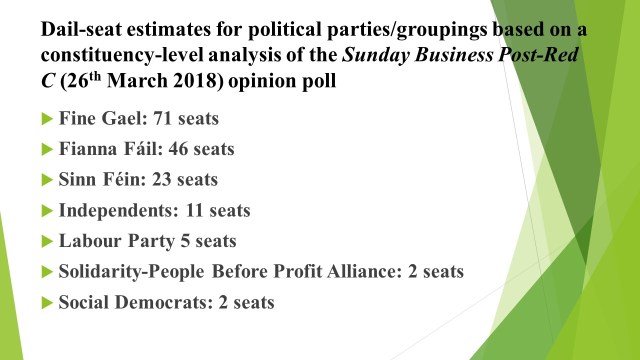
Looking at the February/March 2018 polls: Constituency-level analysis of the 26th March Sunday Business Post-Red C opinion poll and other polls

Adrian Kavanagh, 26th March 2018

As the Electoral (Amendment) (Dáil Constituencies) Bill 2017 was officially passed into law just before Christmas 2017, this will be the first set of polls analyses to use the new Constituency Commission electoral boundaries as the basis for the analysis. The translation of 2016 support figures onto these new constituency units is not a perfect one, alas, given the lack of tally figures in some cases (e.g. the Laois, Offaly and Kildare constituencies) or the lack of time to carry out the necessary background analyses in other cases (e.g. the constituencies in the West and North West). Where it has been possible to take account of tally figures, the constituency support estimates are based on the votes cast in the new constituency units in those cases.

Slide1

The early opinion polls in 2018 have offered relatively good news for Fine Gael, although the party’s support level has fluctuated, at times, across these Winter/Spring 2018 polls. Furthermore, the combined vote Fine Gael/Fianna Fáil vote share across all of these polls has generally averaged out around the 60% level. This, admittedly, represents a lower support level than the combined vote levels commanded by these parties before the onset of the Economic Crisis in 2008, but these poll figures seem to mark another stage in the recovery of the “Civil War” parties, given that the two parties won less than half of the votes cast nationally at the 2016 General Election. Is the old “Civil War” politics model on the way back? Maybe, maybe not… Although it must be noted that when the other “Civil War” party, Sinn Fein, is factored in the combined support levels for the “Civil War parties” comes in between 75% and 80% in these two polls – up by over 15% on the combined support levels won by these parties at the 2016 election. As the larger parties advance, the smaller parties and Independents all fall back, while the Labour Party support levels have tended to remain lower (especially in certain polls) than the already very low levels of support won by that party at the 2016 contest.  Continue reading

Posted in opinion polls | Leave a comment

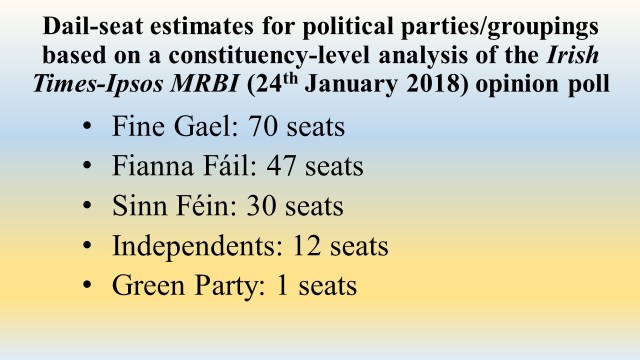
The January polls and the Impact of the Constituency Commission 2017 report changes: Constituency-level analysis of the Irish Times-Ipsos MRBI (24th January 2018), Sunday Times- Behaviour & Attitudes (21st January 2018) and Sunday Business Post-Red C (28th January 2018) opinion polls.

Adrian Kavanagh, 26th January 2018

As the Electoral (Amendment) (Dáil Constituencies) Bill 2017 was officially passed into law just before Christmas 2017, this will be the first polls analyses to use the new Constituency Commission electoral boundaries as the basis for the analysis. The translation of 2016 support figures onto these new constituency units is not a perfect one, alas, given the lack of tally figures in some cases (e.g. the Laois, Offaly and Kildare constituencies) or the lack of time to carry out the necessary background analyses in other cases (e.g. the constituencies in the West and North West). Where it has been possible to take account of tally figures, the constituency support estimates are based on the votes cast in the new constituency units in those cases.

Slide1

The first two opinion polls of 2018 – the Sunday Times-Behaviour and Attitudes poll (21st January) and the Irish Times-Ipsos MRBI poll (25th January) – offer relatively good news for Fine Gael, although the party’s support level has dipped slightly relative to the level of support registered by the party in the December 2017 polls. Furthermore, the combined vote Fine Gael/Fianna Fáil vote share in these two polls stands at just under 60%. This, admittedly, is lower than the combined vote levels commanded by these parties before the onset of the Economic Crisis in 2008, but these poll figures seem to mark another stage in the recovery of the “Civil War” parties, given that the two parties won less than half of the votes cast nationally at the 2016 General Election. Is “Civil War” politics back? Maybe, maybe not…although it must be noted that when the other “Civil War” party, Sinn Fein, is factored in here, the combined support levels for the “Civil War parties” comes in between 75% and 80% in these two polls – up by over 15% on the combined support levels won by these parties at the 2016 election. As the larger parties advance, the smaller parties and Independents all fall back, while the Labour Party support levels remain significantly lower (especially in the Irish Times-Ipsos MRBI poll) than the already very low levels of support won by that party at the 2016 contest.  Continue reading

Posted in Uncategorized | Leave a comment

“Is There Anything To Be Said For Having A General Election?”: Constituency-level analysis of the Irish Times-Ipsos MRBI opinion poll (7th December 2017)

Adrian Kavanagh, 7th December 2017

Slide1

Following on the general election speculation of recent weeks and a decidedly unpromising Red C poll from the previous weekend, this morning’s Irish Times-Ipsos MRBI opinion poll offers very good news for Fine Gael, with this showing Fine Gael on a support level similar to that won by the party in the 2011 General Election. There is also good news for Sinn Féin, but not good news for Fianna Fáil, with that party’s support level falling – relative to the previous Ipsos-MRBI poll from October – in line with the surge in Fine Gael support. However, the combined vote Fine Gael/Fianna Fail vote share in this poll stands at 61%. This, admittedly, is lower than the combined vote levels commanded by these parties before the onset of the Economic Crisis in 2008, but these poll figures seem to mark another stage in the recovery of the “Civil War” parties. Is “Civil War” politics back? Maybe, maybe not…although it must be noted that when the other “Civil War” party, Sinn Fein, is factored in here, the combined support levels for the “Civil War parties” comes in 80% in this poll – up by over 15% on the combined support levels won by these parties at the 2016 election. As the larger parties advance, the smaller parties and Independents all fall back, with the exception of the Green Party, while the Labour Party support levels remain significantly lower than the already very low levels of support won by that party at the 2016 contest. 

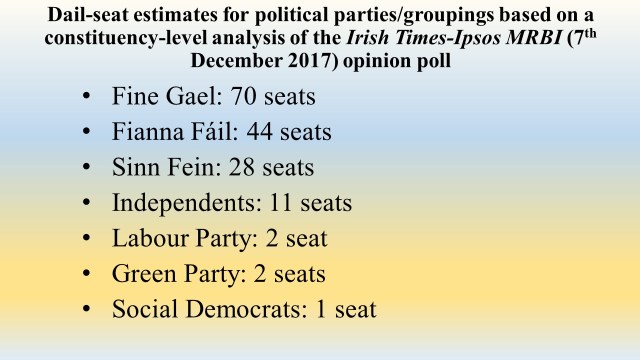
The 7th December 2017 Irish Times-Ipsos MRBI opinion poll etimates party support levels as follows: Fianna Fail 25% (down 4% relative to the previous Ipsos MRBI opinion poll), Fine Gael 36% (up 5%), Sinn Fein 19% (NC), Independents and Others 16% (down 3%) – including Solidarity-People Before Profit 1%, Social Democrats 1%, Green Party 3%, Independents 9% – Labour Party 4% (NC). My constituency-level analysis of these poll figures estimates that party seat levels, should such national support trends be replicated in an actual general election, would be as follows: Fianna Fail 44, Fine Gael 70, Sinn Fein 28, Labour Party 2, Green Party 2, Social Democrats 1, Independents 11.     Continue reading

Posted in Uncategorized | Leave a comment

The Empire Strikes Back: Constituency-level analysis of the Irish Times-Ipsos MRBI opinion poll (5th October 2017)

Adrian Kavanagh, 5th October 2017

Slide1

The trends evidenced in the most recent other opinion polls are readily apparent in this morning’s Irish Times-Ipsos MRBI opinion poll, which shows support levels for Fine Gael and Fianna Fail (and Sinn Fein) that are notably higher than the levels won by those parties at the 2016 General Election. This election had marked the first point in history in which the combined vote share for the traditional “main parties” of Irish politics, Fine Gael and Fianna Fail, came in under the 50% mark. However, the combined vote Fine Gael/Fianna Fail vote share in this poll stands at 60%. This, admittedly, is lower than the combined vote levels commanded by these parties before the onset of the Economic Crisis in 2008, but these poll figures seem to mark another stage in the recovery of the “Civil War” parties. Is “Civil War” politics back? Maybe, maybe not…although it must be noted that when the other “Civil War” party, Sinn Fein, is factored in here, the combined support levels for the “Civil War parties” comes in at just under 80% in this poll – up by around 15% on the combined support levels won by these parties at the 2016 election. As the larger parties advance, the smaller parties and Independents all fall back, with the exception of the Green Party, while Labour support levels are significantly lower than the already very low levels of support won by that party at the 2016 contest. The Empire Strikes Back? Probably… Continue reading

Posted in Uncategorized | Leave a comment

Flashback: Seat estimates for Irish Independent-Millward Brown Lansdowne and Paddy Power-Red C opinion polls, 23rd February 2011

Adrian Kavanagh, 27th September 2017

A look back at an old constituency-level poll analysis – this one being the last analyses carried out ahead of the so-called “earthquake” election of 2011. This article was originally posted on what was then the Irish Political Reform website on 23rd February 2011, but this website has now become the Irish Politics Forum. The analyses naturally did not get the party seat levels exactly right (the poll figures did not match up with the actual vote patterns in the subsequent election and no model is that good). However, the figures were in the “general ballpark” in relation to the final tallies for the different parties and groupings. Indeed, the Millward Brown poll analysis did correctly predict a Labour Party seat level of 37 seats and a Sinn Fein seat level of 14 seats, while both models correctly predicted that the Green Party would win no seats. Fianna Fail fared better in the actual election than they did in these polls (and indeed the exit poll released on the morning of the election), but this higher support was offset by the impact of vote transfers on election day, which tended to especially favour Fine Gael and Labour and especially punish the government parties. Many commentators ahead of the election had expected that Fianna Fail would ultimately end up with around 40 seats, but the numbers in the poll analyses consistently pointed to more dramatic Fianna Fail losses if their national support levels remained in the mid-to-high teens. Fine Gael seat levels here were over-estimated due to the fact that the party was on a higher support level in these polls than they subsequently won in the actual election, but the analyses did capture the sense that Fine Gael could come relatively close to an overall majority with a national support level in the mid to high 30s. The difficulties faced in analysing/factoring in the “Others” grouping are readily evident here! Continue reading

Posted in General Election, opinion polls | Tagged , , , , , , , | Leave a comment

Blue Tide Rising? Constituency-level analysis of the September 2017 opinion polls

Adrian Kavanagh, 26th September 2017

SundayBusinessPostRedC_24September2017

With the exception of the June Ireland Thinks/Daily Mail opinion poll, Fine Gael did not seem to be experiencing an immediate “Leo-leap” in the polls carried out following the change of party leader some months ago. The first few polls carried out just before/at the start of the new Dail term do offer a more attractive scenario for the government party, with gains in support being evident in the latest Sunday Business Post-Red C opinion poll and especially in the recent Sunday Times-Behaviour & Attitudes and Ireland Thinks/Daily Mail opinion polls. All in all, the general trend in polls carried out over the past few months suggest that Fine Gael have made notable gains relative to the low levels of support that were evident for that party in the opinion polls of Winter/early Spring 2017 and that they have now re-established their position as the most popular political party/grouping in the land. Both These trends also suggest that Fianna Fail and Sinn Fein seem likely to be gaining support also, relative the levels won by these parties at the February 2016 election, although support levels for Independents have declined notably since that contest and Labour’s support levels still remain lower than the low levels of support won by them in that contest. Support levels for other smaller/”minor” parties and groupings are harder to glean, with the seat estimates for these parties varying notably from poll to poll (for these parties a 1% gain/decline in national support levels could have a very significant impact on their overall number of seats nationally).

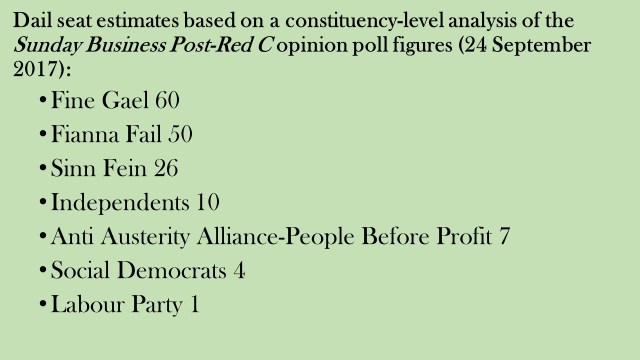
The 24th September 2017 Sunday Business Post-Red C opinion poll estimates party support levels as follows: Fianna Fail 26% (up 2% relative to the previous Red C opinion poll), Fine Gael 30% (up 3%), Sinn Fein 16% (down 2%), Independents and Others 23% (down 2%) – including Solidarity-People Before Profit 4%, Social Democrats 4%, Green Party 2%, Renua 1%, Independents 12% – Labour Party 5% (down 1%). My constituency-level analysis of these poll figures estimates that party seat levels, should such national support trends be replicated in an actual general election, would be as follows: Fianna Fail 50, Fine Gael 60, Sinn Fein 26, Solidarity-People Before Profit 7, Social Democrats 4, Labour Party 1, Independents 10.  

The 25th September 2017 Ireland Thinks/Daily Mail opinion poll estimates party support levels as follows: Fianna Fail 29% (up 3% relative to the previous Ireland Thinks opinion poll), Fine Gael 32% (up 1%), Sinn Fein 14% (down 2%), Independents and Others 23% (NC) – including Solidarity-People Before Profit 2%, Social Democrats 2%, Green Party 3%, Independents 12% – Labour Party 5% (down 2%). My constituency-level analysis of these poll figures estimates that party seat levels, should such national support trends be replicated in an actual general election, would be as follows: Fianna Fail 55, Fine Gael 66, Sinn Fein 19, Labour Party 2, Social Democrats 2, Green Party 1, Solidarity-People Before Profit 1, Independents 12.  

The 17th September 2017 Sunday Times-Behaviour & Attitudes opinion poll estimates party support levels as follows: Fianna Fail 25% (down 5% relative to the previous Behaviour & Attitudes opinion poll), Fine Gael 33% (up 4%), Sinn Fein 19% (up 1%), Independents and Others 23% (up 1%) – including Solidarity-People Before Profit 1%, Social Democrats 1%, Green Party 2%, Independents 13% – Labour Party 5% (NC). My constituency-level analysis of these poll figures estimates that party seat levels, should such national support trends be replicated in an actual general election, would be as follows: Fianna Fail 45, Fine Gael 69, Sinn Fein 31, Labour Party 2, Solidarity-People Before Profit 1, Independents 10.  

Continue reading

Posted in General Election, opinion polls | Tagged , , , , , , , | 1 Comment

Fine Gael experiencing a “Leo-Leap”?: Constituency-level analysis of the Ireland Thinks/Dail Mail opinion poll (26 June 2017) and other Summer 2017 polls

Adrian Kavanagh, 26th June 2017

IrelandThinksDailyMail_26June2017A

Having experienced a series of poor figures across opinion polls in the earlier months of 2017, the Fine Gael party fortunes did improve somewhat in the polls carried out in March and April. Changes of party leadership, however, often do result in a “bounce” in opinion poll support levels for politician parties and this is what transpires in the Latest in the series of Ireland Thinks/Daily Mail opinion polls, with a six percentage point gain in support levels being recorded by Fine Gael weeks after Leo Varadkar became the new party leader (and was subsequently elected Taoiseach). This poll is perhaps particularly significant as it is the first poll to be published after Leo Varadkar became the new Fine Gael party leader. Out of the other parties/groupings, this also amounts to a good opinion poll for the Labour Party and this poll shows that party on one of its highest support levels out of any of the opinion polls carried out in the wake of the February 2016 General Election. Most of the other parties/groupings – with the exception of the Green Party – do lose ground in this poll, with a four percentage point drop in support levels being recorded for the Independents grouping.   

The 26th June Ireland Thinks/Daily Mail opinion poll estimates party support levels as follows: Fianna Fail 26% (down 1% relative to the previous Ireland Thinks/Daily Mail opinion poll), Fine Gael 31% (up 6%), Sinn Fein 16% (down 1%), Independents and Others 19% (down 6%) – including Solidarity-People Before Profit 2%, Social Democrats 2%, Green Party 4%, Independents 11% Labour Party 7% (up 2%). My constituency-level analysis of these poll figures estimates that party seat levels, should such national support trends be replicated in an actual general election, would be as follows:  Fianna Fail 46, Fine Gael 63, Sinn Fein 26, Labour Party 8, Solidarity-People Before Profit 1, Social Democrats 2, Green Party 3, Independents 9.   Continue reading

Posted in General Election, opinion polls | Tagged , , , , , , , | Leave a comment

Ministerial and Junior Ministerial appointments by constituency (June 2017)

Adrian Kavanagh, 22nd June 2017

This post will look at ministerial appointments by constituency and by region, following the election of Leo Varadkar as new Taoiseach last week and the subsequent appointment of a new cabinet, including Fine Gael and Independent Dail deputies, as well as the junior ministerial appointments which followed a few days later. With thirty four ministerial and junior ministerial posts to be distributed, this meant that just 21.6% of Dail deputies (excluding the Ceann Comhairle) will be taking up these posts, but this percentage increases dramatically to 58.6% when only the Dail deputies from Fine Gael and the group of Independents supporting the Government are factored in.

Senior Minsters Junior Ministers
Female Male Female Male
Carlow-Kilkenny 1
Cavan-Monaghan 1
Clare 1
Cork East 1
Cork North Central
Cork North West 1
Cork South Central 1
Cork South West 1
Donegal 1
Dublin Central 1
Dublin Mid West 1
Dublin Fingal
Dublin Bay North 1 1
Dublin North West
Dublin Rathdown 1
Dublin South Central 1
Dublin Bay South 1
Dublin South West 1
Dublin West 1
Dun Laoghaire 1
Galway East 1
Galway West 1
Kerry County 1
Kildare North
Kildare South
Laois 1
Offaly
Limerick City
Limerick County 1
Longford-Westmeath 1
Louth
Mayo 1
Meath East 1 1
Meath West 1
Roscommon-Galway 1
Sligo-Leitrim
Tipperary
Waterford 1
Wexford 2
Wicklow 1 1
STATE 4 11 3 16

In terms of the senior ministerial/cabinet positions, four (26.7%) of these have been taken up by female deputies – a similar level/number to the female appointments made in March 2016, but up notably on the two positions that were awarded to females in March 2011 following the formation of the previous government. The number of female junior ministers has fallen by one, however – with the percentage of junior ministers who are female falling from 22.2% (Spring 2016 appointments) to 15.8%.

As with the March 2016 appointments, Dublin dominates in terms of the regional distribution of senior ministerial posts, but not to the same extent as was the case in 2011, with seven (46.7%) – as opposed to nine (60.0%) in March 2011 – of the cabinet posts being taken by deputies from the Dublin region. All of the Dublin-based independent Dail deputies who are supporting the government have either been appointed to full cabinet positions (Katherine Zappone, Shane Ross) or to a super-junior ministerial position (Finian McGrath). Five of the fourteen Dublin-based Fine Gael Dail deputies (35.7%) were appointed to the Cabinet. Seven Cabinet positions were divided out between the 36 Fine Gael Dail deputies from the constituencies outside of the Dublin region (19.5%).

Following Michael Noonan’s retirement from the post of Minister for Finance, only two (13.3%) of the cabinet posts are now held by deputies from the Munster region. Both the Leinster (rest of Leinster) and Connacht-Ulster regions, by contrast, now have three senior ministers hailing from these regions.

With Simon Coveney added into the equation, urban-based deputies now account for well over half (53,3%) of all cabinet positions.

Given the very obvious Dublin and urban bias that is still evident in terms of senior ministerial appointments, Geography does not seem to have played a significant influence in shaping these. The precedents from the 2011 and 2016 appointments and the 2014 reshuffle suggested that there would be a somewhat greater degree of geographical balance evident in relation to the junior ministerial appointments, especially given that appointments involving a number of rural-based independent Dail deputies need to be factored in here. This indeed turned out to be the case, as Dublin only accounted for three of the junior ministerial appointments (15.8% of the total). Connacht-Ulster also accounted for three of these appointments (15.8%)  – down from four in Spring 2016 – while Munster accounted for six (31.6%) of these. The region that fared best in this regard was Leinster, which accounted for seven (36.8% of these appointments). In all, the South European Election constituency accounted for over half of the junior ministerial appointments (52.6%), but just one fifth (20.0%) of the senior ministerial appointments.

15.8% (3) of these junior ministerial appointments were given to female Dail deputies, while 84.2% (16) of these were given to male deputies.

Government TDs seemed to have a much better chance of being appointed to a senior ministerial position if they represented a three seat constituency,  while they had a much better chance of getting a junior ministerial appointment if they represented a five seat constituency. Of the senior ministerial/cabinet appointments, 40.0% of these went to TDs from three seat constituencies, 40.0% of these went to TDs from four seat constituencies and only 20.0% of these went to TDs from three seat constituencies. Of the junior ministerial appointments, only 26.3% of these went to TDs from three seat constituencies, 31.6% of these went to TDs from four seat constituencies and 42.1% of these went to TDs from three seat constituencies.

Thirty constituencies now have either a minister or a junior minister. Ten constituencies do not have a minister or junior minister, namely Cork North-Central, Dublin Fingal, Dublin North-West, Kildare North, Kildare South, Offaly, Limerick City, Louth, Sligo-Leitrim and Tipperary. (There are currently no Government TDs representing the Tipperary constituency.)

Posted in Ministers | Tagged | Leave a comment

Predicting Seat Levels in the 2017 UK General Election based on recent Opinion Poll Figures (8th June 2017)

Adrian Kavanagh, 8th June 2017

It’s Election Day in the United Kingdom. What do the final opinion poll figures of the general election campaign suggest in relation to the likely number of seats that each party will win in that contest? The opinion polls across the final few weeks of the campaign showed Labour gaining significant ground on the Conservatives, albeit not to such an extent that these improved Labour fortunes seem likely to prevent the Conservatives winning another majority in the House of Commons after the June 8th election. Both of the two largest parties, as of now, are well ahead of the support levels that they won at the 2015 General Election, meaning that the smaller parties are at risk of being squeezed out in this contest.

HouseofCommonsseatestimates_8June2017A

Continue reading

Posted in General Election, opinion polls, United Kingdom | Tagged , , , , , , , | Leave a comment