Labour Party candidates for the 2019 Local Elections

Adrian Kavanagh, First posted 2nd July 2018 with updates as new candidate nominations announced 

The first of a series rolling blog posts in which I will detail the latest information as to candidate selections for the 20109 Local Elections, relating to the different political parties and grouping and/or candidate declarations (as in the case of the non-party grouping). The rule of thumb here will be that I add party candidates only after they have been officially selected to run for the party at a selection convention, or by some other means of candidate selection (e.g. added by party headquarters).

The post focuses on the Labour Party candidate selections. In the Autumn of 2018 the Labour Party had forty seven City/County Councillors, according to my best estimates. Declining support levels in the years following General Election 2011 saw Labour losing a large number of seats at the 2014 Local Elections and the 2016 General Election. So the 2019 Local Elections will prove to be very important for the Labour Party in terms of rebuilding the party in the wake of the losses in 2014 and 2016 (and also a number of defections in the period between 2011 and 2016).

8th May 2019: One hundred and eleven candidates are listed on this page so far.

Forty five of these candidates (40.5%) are women and sixty six are men (59.5%). As far as I am aware, at least ninety four Labour Party selection conventions have taken place so far. With one hundred and sixty six electoral areas being contested, this means that seventy two electoral areas will not have a Labour Party candidate in these elections.

Thirty six of these Labour Party local election candidates are currently sitting City/County Councillors (incumbents) – 33.3% of the total. 34.8% of male Labour local election candidates are incumbents, as opposed to 31.1% of female Labour candidates. At least thirteen (11.7%) other Labour Party candidates have previously held some form of electoral office.

The candidates contesting the 2019 Local Elections for the Labour Party include the following:

CandidatesLabour Candidates
Carlow18.
Carlow7Kevin Byrne
Tullow6Cllr. William Paton
Muinebeag5Cllr. William Quinn
Cavan18.
Bailieborough-Cootehill6Mary Roche
Ballyjamesduff6.
Cavan-Belturbert6Liam van der Spek
Clare28.
Ennis7Seamus Ryan
Killaloe5.
Shannon7.
Ennistymon4.
Kilrush5.
Cork County55.
Carrigaline6.
Bandon-Kinsale6.
Macroom6.
Cobh6Cllr. Cathal Rasmussen
Midleton7Eric Nolan
Fermoy6David Kenneally
Kanturk4.
Mallow5James Kennedy
Bantry-West Cork4.
Skibbereen-West Cork5.
Cork City31.
Cork City North East6John Maher
Cork City North West6Luke Carroll
Cork City South Central6Luke Field
Cork City South East6Peter Horgan
Cork City South West7Ciara Kennedy
Donegal37.
Donegal6.
Glenties6Seamus Rodgers
Milford3.
Buncrana5.
Letterkenny7.
Carndonagh4Cllr. Martin Farren
Lifford-Stranorlar6.
Dublin City63.
Ballyfermot-Drimnagh5Michael O’Sullivan
Ballymun-Finglas6Cllr. Andrew Montague
Artane-Whitehall6Cllr. Alison Gilliland
Donaghmede5Shane Folan
Cabra-Glasnevin7Marie Sherlock Doherty,
Declan Meenagh,
Cllr. Áine Clancy
Clontarf6Cllr. Jane Horgan-Jones
Kimmage-Rathmines6Cllr. Mary Freehill
North Inner City7Joe Costello
South West Inner City5Cllr. Rebecca Moynihan
South East Inner City5Kevin Donoghue
Pembroke5Cllr. Dermot Lacey
Dun Laoghaire-Rathdown40.
Blackrock6Cllr. Deirdre Kingston
Dún Laoghaire7Valerie McDermott,
Juliet O’Connell
Dundrum7Cllr. Peter O’Brien
Glencullen-Sandyford7Cllr. Lettie McCarthy
Killiney-Shankill7Cllr. Carrie Smyth,
Cllr. Denis O’Callaghan
Stillorgan6Paul Gordon
Fingal County40.
Balbriggan5Seána Ó Rodaigh
Rush Lusk5Cllr. Robert O’Donoghue,
Corina Johnston
Castleknock6John Walsh
Howth-Malahide7Cllr. Brian McDonagh
Blanchardstown-Mulhuddart5Cllr. Mary McCamley
Ongar5Elaine Dooley
Swords7Cllr. Duncan Smith,
Yulia Ghumman
South Dublin County40.
Clondalkin7Robert Dowds
Palmerstown-Fonthill5David Eaton
Lucan5Joanna Tuffy
Tallaght Central6Denis Mackin
Tallaght South5.
Rathfarnham-Templeogue7Cllr. Pamela Kearns,
Cllr. Paddy Cosgrave 
Firhouse-Bohernabreena5Aideen Carberry
Galway City18.
Galway City Central6John McDonagh
Galway City East6Liam Boyle
Galway City West6Cllr. Nial McNelis
Galway County39.
Athenry-Oranmore7Marian Spelman
Gort Kinvara5.
Ballinasloe6.
Conamara North4.
Conamara South5.
Loughrea5.
Tuam7.
Kerry33.
Killarney7Marie Moloney
Listowel6.
An Daingean3.
Kenmare6Luke Crowley-Holland
Castleisland4.
Tralee7Cllr. Terry O’Brien,
Ben Slimm
Kildare40.
Athy5Cllr. Aoife Breslin,
Cllr. Mark Wall
Celbridge4Ciara Galvin
Leixlip3Mairead Beades
Maynooth5Angela Feeney
Clane5.
Kildare5Paul Hutchinson
Newbridge6Ciara O’Reilly
Naas7Cllr. Ann Breen,
Fergus Carpenter
Kilkenny24.
Castlecomer6Denis Hynes
Kilkenny 7Andrea Cleere
Callan-Thomastown6.
Piltown5Cllr. Tomás Breathnach
Laois19.
Borris in Ossory-
Mountmellick
6.
Graiguecullen-Portarlington6Eoin Barry
Portlaoise7Cllr. Noel Tuohy
Leitrim18.
Ballinamore6.
Carrick-on-Shannon6.
Manorhamilton6.
Limerick40.
Limerick City East7Cllr. Elena Secas
Limerick City North7Anne Cronin,
Conor Sheehan
Limerick City West7Cllr. Joe Leddin
Adare-Rathkeale6.
Cappamore-Kilmallock7.
Newcastle West6.
Longford18.
Ballymahon6.
Granard5.
Longford7.
Louth29.
Ardee6.
Drogheda Urban6Cllr. Paul Bell,
Cllr. Pio Smith
Drogheda Rural4Michelle Hall
Dundalk-Carlingford6.
Dundalk-South7.
Mayo30.
Ballina6.
Castlebar7Kamal Uddin
Claremorris6.
Swinford4.
Belmullet3.
Westport4.
Meath40.
Ashbourne6.
Kells7Aaron Byrne
Laytown-Bettystown7Annie Hoey
Navan7.
Ratoath7.
Trim6Tracey McElhinney
Monaghan18.
Ballybay-Clones5.
Carrickmacross-
Castleblaney
6.
Monaghan7.
Offaly19.
Birr6.
Edenderry6.
Tullamore7.
Roscommon18.
Athlone (Roscommon)6.
Boyle 6.
Roscommon6.
Sligo18.
Ballymote-Tobercurry7.
Sligo-Drumcliff5.
Sligo-Strandhill6Nessa Cosgove 
Tipperary40.
Carrick-on-Suir5Sarah Dunne
Cahir4.
Cashel-Tipperary7Robert O’Donnell
Clonmel6.
Nenagh5Louise Morgan Walsh
Newport4Cllr. Fiona Bonfield
Roscrea-Templemore4.
Thurles5.
Waterford32.
Waterford City East6.
Waterford City South6Seamus Ryan
Tramore-Waterford City West6.
Portlaw-Kilmacthomas5Ger Barron
Dungarvan6Thomas Phelan
Lismore3Cllr. John Pratt
Westmeath20.
Athlone (Westmeath)5.
Moate4Cllr. Johnnie Penrose
Mullingar  6Mark Scally,
Margaret Lynam-Sweeney
Kinnegad5Denis Leonard,
Lorraine Scally
Wexford34.
Gorey6Cllr. Robert Ireton
Kilmuckridge4Nicky Wafer
Enniscorthy6.
New Ross6Bridín Moloney
Rosslare5.
Wexford7Cllr. George Lawlor,
Joe Ryan,
Maura Bell
Wicklow32.
Arklow6.
Baltinglass6.
Bray East4Anne Ferris
Bray West4Ian McGahon
Greystones6Anna Waithira Burke
Wicklow6Paul O’Brien

Fiona Bonfield and Viginia O’Dowd, were both selected as Labour Party local election candidates on 29th June 2018 (as reported subsequently on by The Nenagh Guardian (9th July 2018)). Virigina O’Dowd subsequently withdrew from the election contest and will be replaced as Labour’s Nenagh candidate by Louise Morgan Walsh, as reported by the Tipperary Live website (20th February 2019). Liam van der Spek was identified as the party’s candidate for the Cavan-Belturbet electoral area by the The Anglo-Celt (21st June 2018). Cllrs Pio Smith and Paul Bell were selected to contest the Drogheda Urban electoral area in July 2018. A series of selections for the Dublin Mid-West Dáil constituency area on 30th July 2018 saw Breda Bonner, Joanna Tuffy and David Eaton being selected as Labour Party candidates for the three different electoral areas located there. On 31st July 2018 John Maher was selected as the candidate for the Cork City North East electoral area.

Jack Walsh was selected as the Waterford City East candidate and Seamus Ryan was selected as the Waterford City South candidate at a selection convention on 14th September 2018. Cllr. Kevin Byrne was selected as the Labour Party candidate for Celbridge at a selection convention in the Celbridge Manor Hotel on 18th September 2018, as reported by the Leinster Leader (19th September 2018). However, he later withdrew from the electoral contest and announced that he was retiring from politics, as reported by the Linster Leader (12th April 2019). Ciara Galvin was selected as the candidate for Celbridge, subsequently, at a second party convention, which took place on 15th April 2019. Peter Horgan was selected as the Cork City South East candidate for the Labour Party at a convention on 24th September 2018. With Cllr. John McGinley not contesting the next local elections, Angela Feeney was selected as the Labour candidate for the Maynooth electoral area at a selection convention on 25th September 2018. Liam van der Spek was officially selected as the candidate for Cavan-Belturbet on 29th September 2018.

A selection convention for the Athy electoral area on October 2nd 2018 selected Cllrs. Aoife Breslin and Mark Wall as Labour Party candidates for that electoral area. Seána Ó Rodaigh was selected to contest the Balbriggan electoral area on 3rd October 2018. Anne Ferris and Ian McGahon were selected as candidates for the Bray West and Bray East electoral areas, respectively, at a convention, which took place on 7th October 2018. Cllr. Anne Breen and Fergus Carpenter were selected as Labour candidates for the seven-seat Naas electoral area at convention which took place on 2nd October 2018, as reported in the Leinster Leader (5th October 2018). A selection convention on 11th October 2018 in Limerick confirmed the selections of Cllr. Elena Secas, Cllr. Joe Leddin, Anne Cronin and Conor Sheehan as candidates in that area. Cllr. Mary Freehill, Cllr. Dermot Lacey and Kevin Donoghue were selected as candidates for the electoral areas covered (mainly) by the Dublin Bay South electoral area at a selection convention on 15th October 2018. luke Field was selected as the Cork City South Central candidates on 22nd October 2018. Selection conventions for the Newbridge and Kildare electoral areas took place on 25th October 2018. Aaron Byrne was selected as the party candidate for the Kells electoral area at a selection convention on 30th October 2018, while Cllrs. Graham Spring and Terry O’Brien, along with Ben Slimm, were selected as candidates for the Tralee electoral area on that same night. Cllr. Graham Spring, however, later withdrew from the local election contest, as reported on the Radio Kerry website (20th March 2019). Mary McCamley and Elaine Dooley were selected as candidates for the Blacnhardstown-Mulhuddart and Ongar electoral areas respectively also on the 30th October. In late October 2018, it was announced that Michelle Hall would be the Labour candidate for the Drogheda Rural electoral area, as reported on the Drogheda Life website (26th October 2018).

Eric Nolan was selected as the Labour Party candidate for Midleton on 12th November 2018. Paul O’Brien was selected as the Labour Party candidates for the Wicklow electoral area on 15th November 2018. Selection conventions for the Kenmare and Killarney electoral areas took place on 27th November 2018, while the Cabra-Glasnevin selection convention took place on 22nd November 2018.

The selection convention for the Carlow electoral area took place on 8th December 2018, while the selection convention for the Wexford (Town) electoral area took place on 12th December 2018.

Jack Walsh was selected to contest Wateford City East, but sadly passed away in January 2019.

Selection conventions for all of the electoral areas in Westmeath County (apart from Athlone) took place on Friday 11th January 2019.

As reported on the Clare FM website (15th January 2019), Seamus Ryan will be the Labour candidate for the Ennis electoral area.

Bridín Moloney was selected as the Labour candidate for New Ross at a selection convention, which took place on 14th January 2019.

The selection convention for the Rush Lusk electoral area took place on 24th January 2019.

The selection convention for the Dún Laoghaire electoral area took place on 31st January 2019.

Cllr. Peter O’Brien, who won a seat in Glencullen-Sandyford in the 2014 elections, was selected as the Dundrum candidate on 6th February 2019, following on Cllr. Grace Tallon’s decision not to contest the May elections.

The Donegal Democrat (12th February 2019) reported that Seamus Rodgers would be the Labour candidate in the Glenties electoral area.

Eoin Barry will contest the Graiguecullen-Portarlington constituency for Labour and his selection will be formally endorsed at a selection convention in late February 2019, as reported by the Laois Nationalist (13th February 2019). This convention took place in the Talbot Hotel on 22nd February 2019, with Cllr. Noel Tuohy also being selected to contest Portlaoise at that same convention, as reported by the Leinster Express (23rd February 2019). In February 2019 it was also announced that Nessa Cosgrove would be the party candidate for Sligo-Strandhill, as reported by the Ocean FM website (13th February 2019).

The selection convention for the Swords electoral area took place on 21st February 2019, while the selection convention for Castlecomer electoral area took place on 20th February 2019.

As reported by the Galway Advertiser (7th March 2019), selection conventions for Galway City West and Galway City Central took place on 3rd March 2019.

Cllr. William Paton was selected to contest the Tullow electoral area on 20th March 2019.

The Leixlip selection convention took place on 21st March 2019, as reported in the Leinster Leader (28th March 2019).

The selection convention for Cork City North West took place on 25th March 2019. The Dungarvan selection convention will take place on 29th March 2019, with Thomas Phelan the only candidate nominated to contest this.

The selection convention for Galway City East took place on 4th April 2019.

Annie Hoey was selected to contest the Laytown-Bettystown electoral area for Labour on 23rd April 2019.
Posted in Candidates, Candidates Local Elections 2019, local elections, Local Elections 2019 | Tagged , , , | Leave a comment

Geographical perspectives on the May 2018 referendum contest

Adrian Kavanagh, 29th May 2018

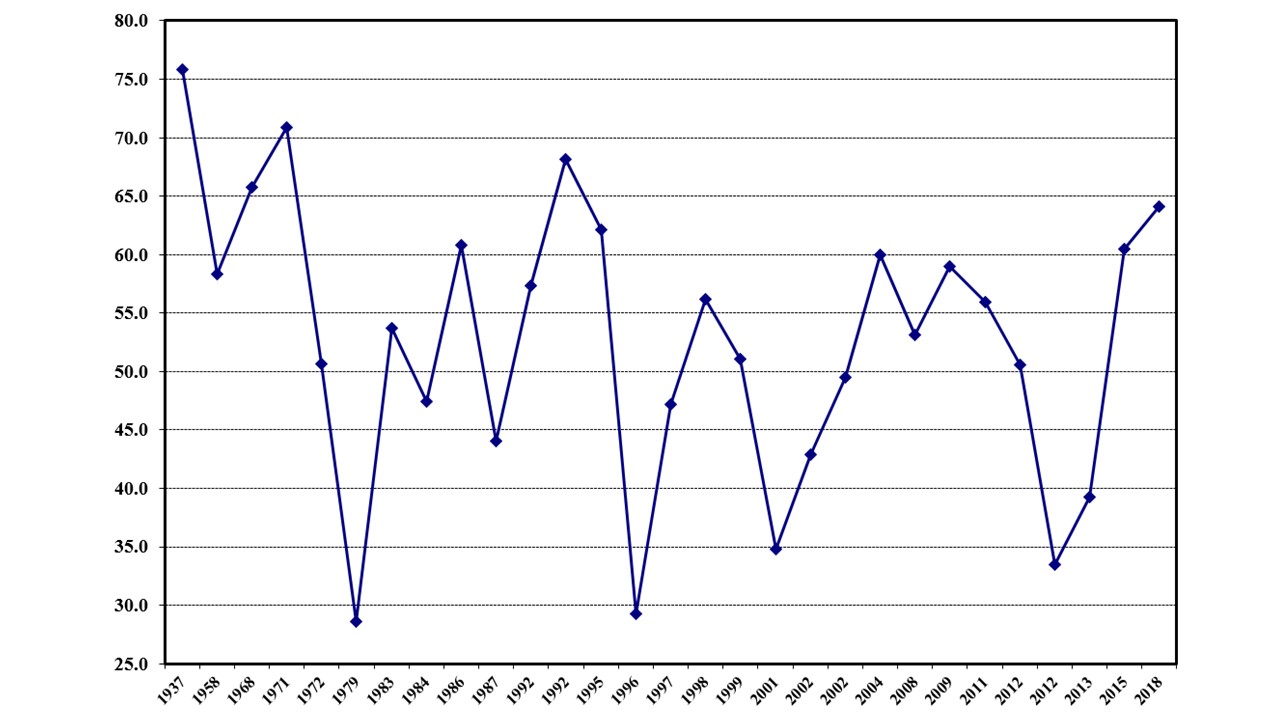
With a national turnout rate of 64.1% – just 1.0% lower than the national turnout level for the 2016 General Election – the Regulation of Termination of Pregnancy (Repeal of 8th Amendment) referendum was passed with 66.4% of the valid votes (almost two-thirds of all the valid votes cast).

ReferendumTurnoutTrends_19372018

Figure 1: Turnout levels at Irish referendum elections, 1937-2018

In actual voter number levels, the turnout at this referendum was 2,159,655, making this the referendum contest with the highest ever number of voters since the foundation of the state. In percentage terms (as shown by Figure 1), this marked the highest turnout level for a referendum contest, or set of referendum contests, since the three referendum contests that took place on the same day as the November 1992 General Election contest. This was also the highest turnout level for a “stand alone” referendum contest since the 1971 referendum on Membership of the EEC. Continue reading →

Posted in Election data, Electoral Geography (voting maps), Referendum elections | Tagged , | Leave a comment

Larger Parties Squeezing Out Smaller Parties and Independents? Constituency-level analysis of Irish Times-Ipsos MRBI (19th April) poll and the Summer 2018 polls

Adrian Kavanagh, 19th April 2018

As the Electoral (Amendment) (Dáil Constituencies) Bill 2017 was officially passed into law just before Christmas 2017, the new Constituency Commission electoral boundaries are now used as the basis for the analysis. The translation of 2016 support figures onto these new constituency units is not a perfect one, alas, given the lack of tally figures in some cases (e.g. Laois, Offaly and Kildare constituencies) or the lack of time to carry out the necessary background analyses in other cases (e.g. constituencies in the West and North West). Where it has been possible to take account of tally figures, the constituency support estimates are based on the votes cast in the new constituency units in those cases.

Slide1

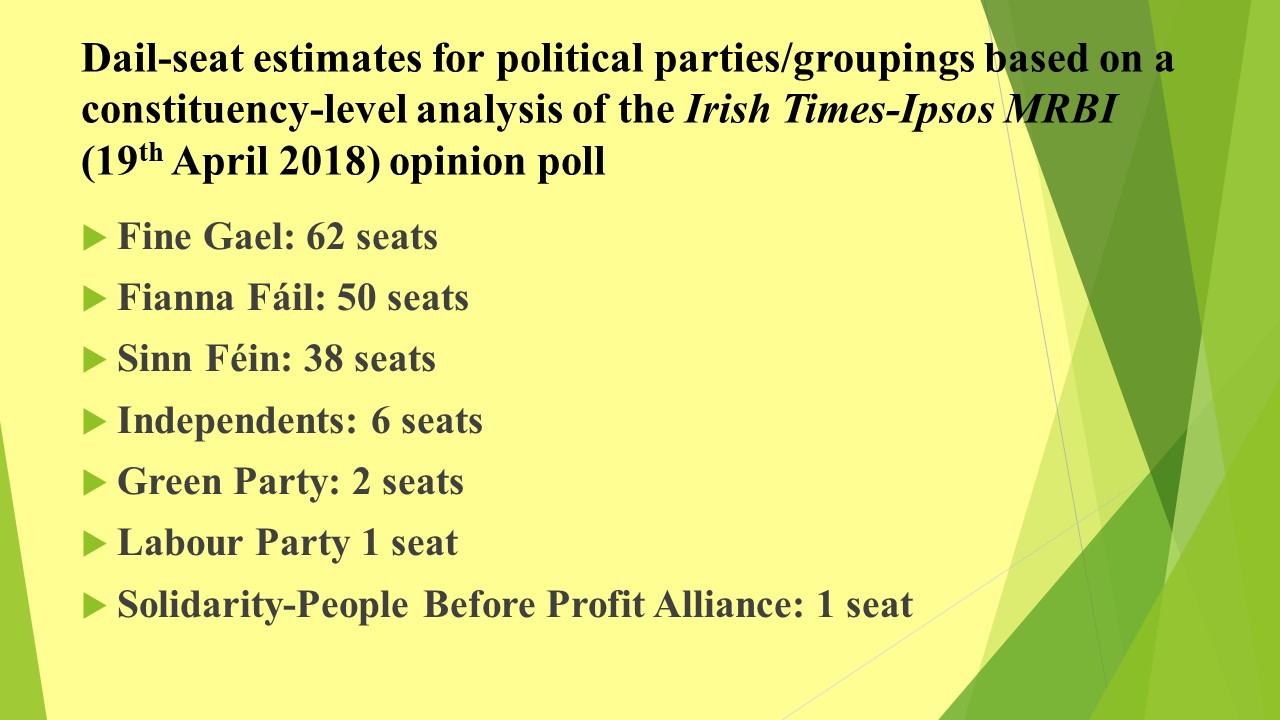
The early opinion polls in 2018 offered very good news for Fine Gael. The party has dropped back somewhat in the more recent polls, but it still remains the strongest party in the state by a distance of a number of percentage points over Fianna Fáil and Sinn Féin. Furthermore, the combined vote Fine Gael/Fianna Fáil vote share across all of these polls has generally averaged out around, or higher than, the 60% level. This, admittedly, represents a lower support level than the combined vote levels commanded by these parties before the onset of the Economic Crisis in 2008, but these poll figures seem to mark another stage in the recovery of the “Civil War” parties, given that the two parties won less than half of the votes cast nationally at the 2016 General Election. Is the old “Civil War” politics model on the way back? Maybe, maybe not… However, it must be noted that when the other “Civil War” party, Sinn Fein, is factored in the combined support levels for the “Civil War parties” comes in at just under 80% in the latest Irish Times-Ipsos MRBI poll – up by around fifteen percent on the combined support levels won by these parties at the 2016 election. As the larger parties advance, the smaller parties and Independents all fall back, while the Labour Party support levels have tended to remain lower (especially in certain polls) than the already very low levels of support won by that party at the 2016 contest.   Continue reading →

Posted in opinion polls | Tagged | Leave a comment

Looking at the February/March 2018 polls: Constituency-level analysis of the 26th March Sunday Business Post-Red C opinion poll and other polls

Adrian Kavanagh, 26th March 2018

As the Electoral (Amendment) (Dáil Constituencies) Bill 2017 was officially passed into law just before Christmas 2017, this will be the first set of polls analyses to use the new Constituency Commission electoral boundaries as the basis for the analysis. The translation of 2016 support figures onto these new constituency units is not a perfect one, alas, given the lack of tally figures in some cases (e.g. the Laois, Offaly and Kildare constituencies) or the lack of time to carry out the necessary background analyses in other cases (e.g. the constituencies in the West and North West). Where it has been possible to take account of tally figures, the constituency support estimates are based on the votes cast in the new constituency units in those cases.

Slide1

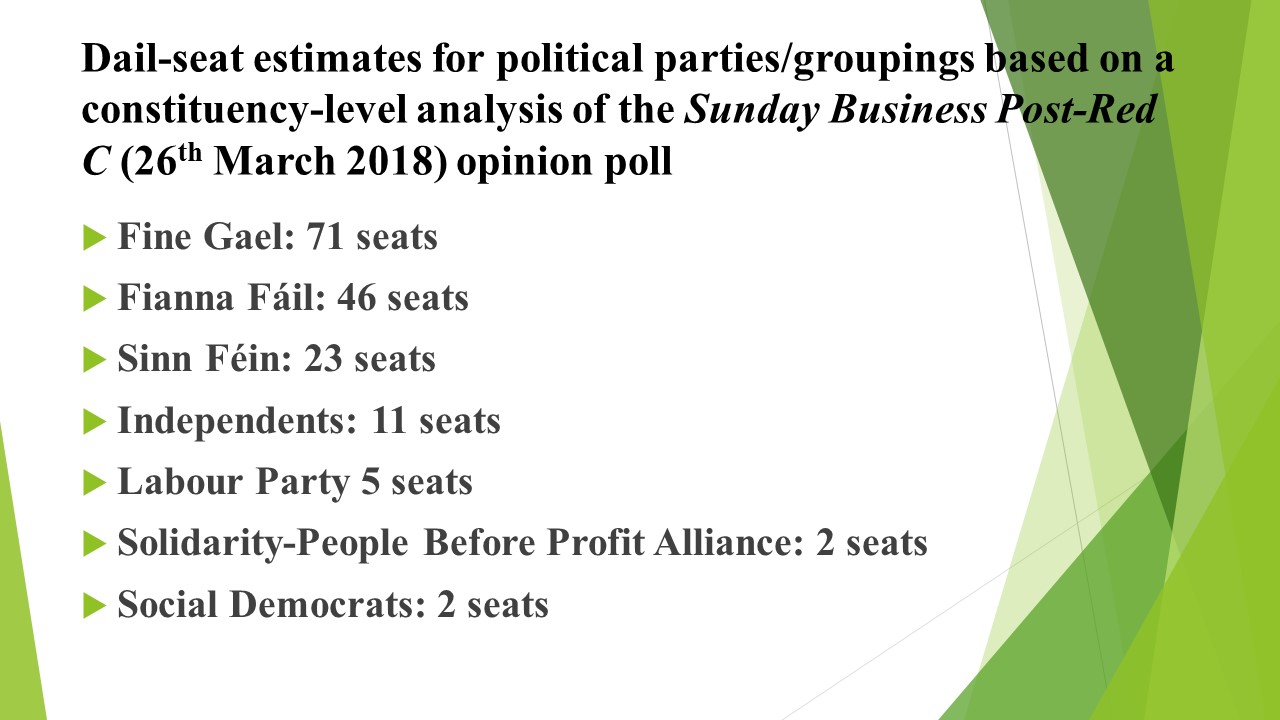
The early opinion polls in 2018 have offered relatively good news for Fine Gael, although the party’s support level has fluctuated, at times, across these Winter/Spring 2018 polls. Furthermore, the combined vote Fine Gael/Fianna Fáil vote share across all of these polls has generally averaged out around the 60% level. This, admittedly, represents a lower support level than the combined vote levels commanded by these parties before the onset of the Economic Crisis in 2008, but these poll figures seem to mark another stage in the recovery of the “Civil War” parties, given that the two parties won less than half of the votes cast nationally at the 2016 General Election. Is the old “Civil War” politics model on the way back? Maybe, maybe not… Although it must be noted that when the other “Civil War” party, Sinn Fein, is factored in the combined support levels for the “Civil War parties” comes in between 75% and 80% in these two polls – up by over 15% on the combined support levels won by these parties at the 2016 election. As the larger parties advance, the smaller parties and Independents all fall back, while the Labour Party support levels have tended to remain lower (especially in certain polls) than the already very low levels of support won by that party at the 2016 contest.  Continue reading →

Posted in opinion polls | Leave a comment

The January polls and the Impact of the Constituency Commission 2017 report changes: Constituency-level analysis of the Irish Times-Ipsos MRBI (24th January 2018), Sunday Times- Behaviour & Attitudes (21st January 2018) and Sunday Business Post-Red C (28th January 2018) opinion polls.

Adrian Kavanagh, 26th January 2018

As the Electoral (Amendment) (Dáil Constituencies) Bill 2017 was officially passed into law just before Christmas 2017, this will be the first polls analyses to use the new Constituency Commission electoral boundaries as the basis for the analysis. The translation of 2016 support figures onto these new constituency units is not a perfect one, alas, given the lack of tally figures in some cases (e.g. the Laois, Offaly and Kildare constituencies) or the lack of time to carry out the necessary background analyses in other cases (e.g. the constituencies in the West and North West). Where it has been possible to take account of tally figures, the constituency support estimates are based on the votes cast in the new constituency units in those cases.

Slide1

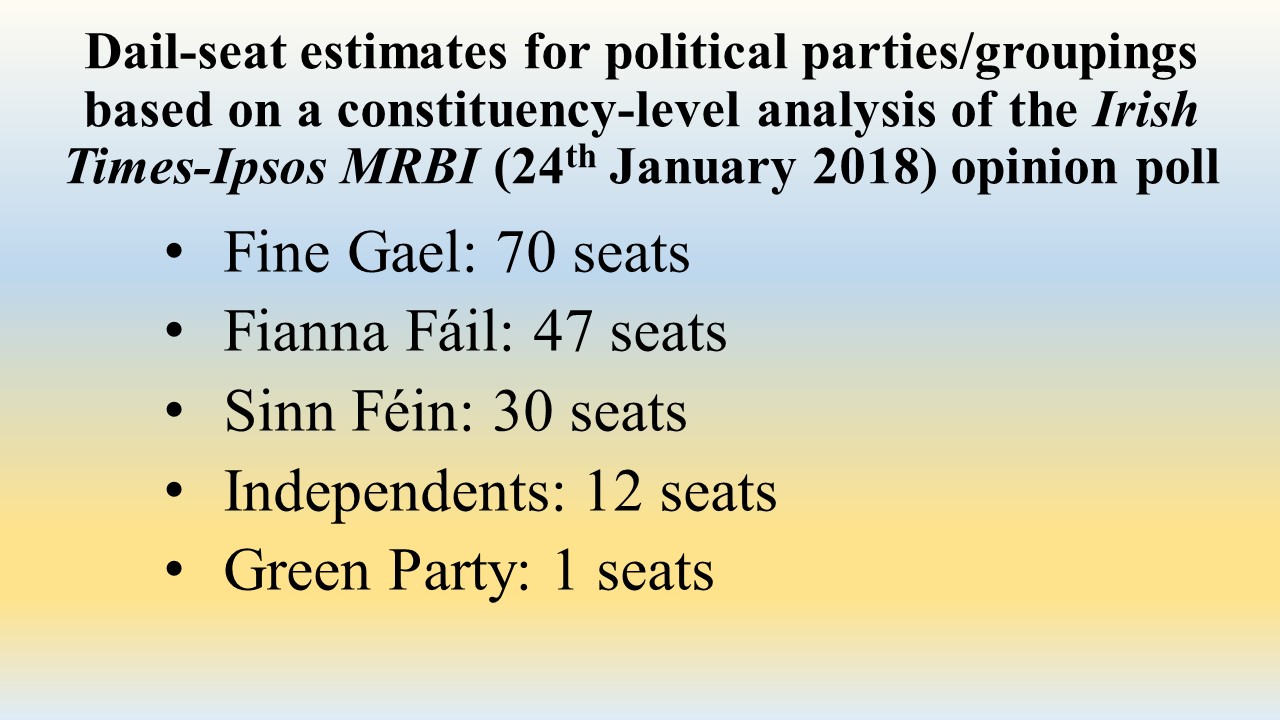
The first two opinion polls of 2018 – the Sunday Times-Behaviour and Attitudes poll (21st January) and the Irish Times-Ipsos MRBI poll (25th January) – offer relatively good news for Fine Gael, although the party’s support level has dipped slightly relative to the level of support registered by the party in the December 2017 polls. Furthermore, the combined vote Fine Gael/Fianna Fáil vote share in these two polls stands at just under 60%. This, admittedly, is lower than the combined vote levels commanded by these parties before the onset of the Economic Crisis in 2008, but these poll figures seem to mark another stage in the recovery of the “Civil War” parties, given that the two parties won less than half of the votes cast nationally at the 2016 General Election. Is “Civil War” politics back? Maybe, maybe not…although it must be noted that when the other “Civil War” party, Sinn Fein, is factored in here, the combined support levels for the “Civil War parties” comes in between 75% and 80% in these two polls – up by over 15% on the combined support levels won by these parties at the 2016 election. As the larger parties advance, the smaller parties and Independents all fall back, while the Labour Party support levels remain significantly lower (especially in the Irish Times-Ipsos MRBI poll) than the already very low levels of support won by that party at the 2016 contest.  Continue reading →

Posted in Uncategorized | Leave a comment

“Is There Anything To Be Said For Having A General Election?”: Constituency-level analysis of the Irish Times-Ipsos MRBI opinion poll (7th December 2017)

Adrian Kavanagh, 7th December 2017

Slide1

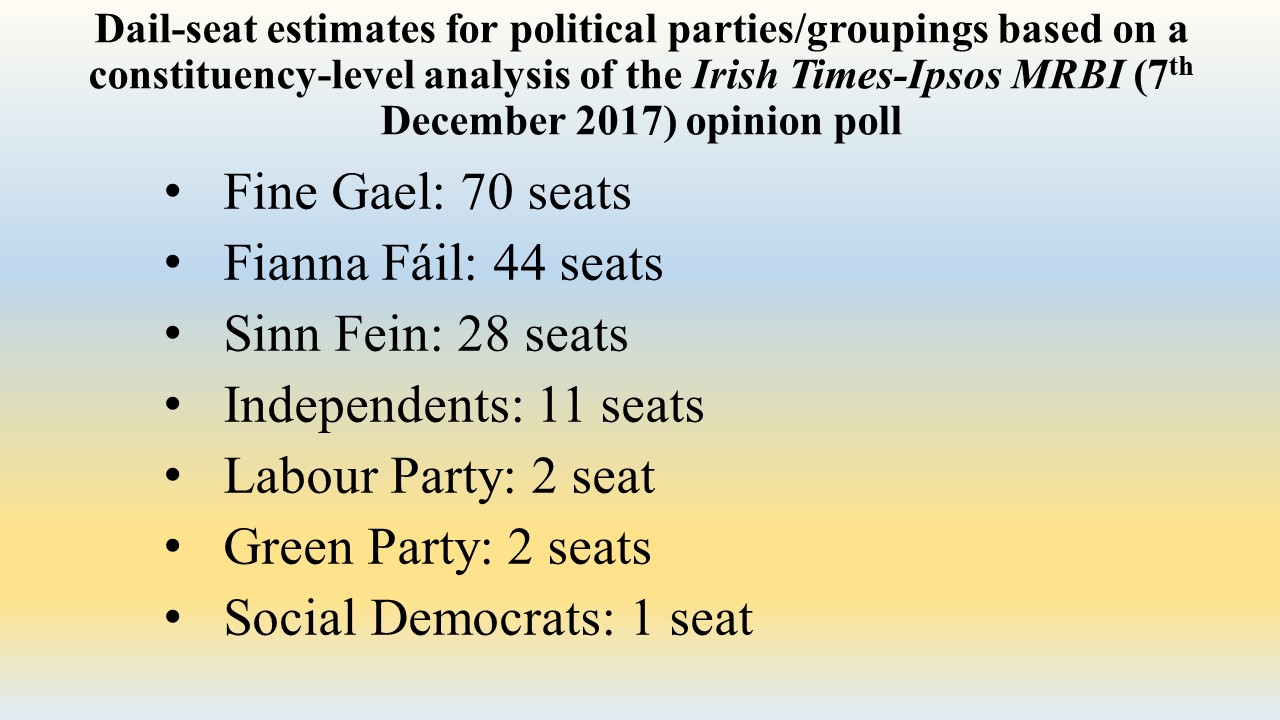
Following on the general election speculation of recent weeks and a decidedly unpromising Red C poll from the previous weekend, this morning’s Irish Times-Ipsos MRBI opinion poll offers very good news for Fine Gael, with this showing Fine Gael on a support level similar to that won by the party in the 2011 General Election. There is also good news for Sinn Féin, but not good news for Fianna Fáil, with that party’s support level falling – relative to the previous Ipsos-MRBI poll from October – in line with the surge in Fine Gael support. However, the combined vote Fine Gael/Fianna Fail vote share in this poll stands at 61%. This, admittedly, is lower than the combined vote levels commanded by these parties before the onset of the Economic Crisis in 2008, but these poll figures seem to mark another stage in the recovery of the “Civil War” parties. Is “Civil War” politics back? Maybe, maybe not…although it must be noted that when the other “Civil War” party, Sinn Fein, is factored in here, the combined support levels for the “Civil War parties” comes in 80% in this poll – up by over 15% on the combined support levels won by these parties at the 2016 election. As the larger parties advance, the smaller parties and Independents all fall back, with the exception of the Green Party, while the Labour Party support levels remain significantly lower than the already very low levels of support won by that party at the 2016 contest. 

The 7th December 2017 Irish Times-Ipsos MRBI opinion poll etimates party support levels as follows: Fianna Fail 25% (down 4% relative to the previous Ipsos MRBI opinion poll), Fine Gael 36% (up 5%), Sinn Fein 19% (NC), Independents and Others 16% (down 3%) – including Solidarity-People Before Profit 1%, Social Democrats 1%, Green Party 3%, Independents 9% – Labour Party 4% (NC). My constituency-level analysis of these poll figures estimates that party seat levels, should such national support trends be replicated in an actual general election, would be as follows: Fianna Fail 44, Fine Gael 70, Sinn Fein 28, Labour Party 2, Green Party 2, Social Democrats 1, Independents 11.     Continue reading →

Posted in Uncategorized | Leave a comment

The Empire Strikes Back: Constituency-level analysis of the Irish Times-Ipsos MRBI opinion poll (5th October 2017)

Adrian Kavanagh, 5th October 2017

Slide1

The trends evidenced in the most recent other opinion polls are readily apparent in this morning’s Irish Times-Ipsos MRBI opinion poll, which shows support levels for Fine Gael and Fianna Fail (and Sinn Fein) that are notably higher than the levels won by those parties at the 2016 General Election. This election had marked the first point in history in which the combined vote share for the traditional “main parties” of Irish politics, Fine Gael and Fianna Fail, came in under the 50% mark. However, the combined vote Fine Gael/Fianna Fail vote share in this poll stands at 60%. This, admittedly, is lower than the combined vote levels commanded by these parties before the onset of the Economic Crisis in 2008, but these poll figures seem to mark another stage in the recovery of the “Civil War” parties. Is “Civil War” politics back? Maybe, maybe not…although it must be noted that when the other “Civil War” party, Sinn Fein, is factored in here, the combined support levels for the “Civil War parties” comes in at just under 80% in this poll – up by around 15% on the combined support levels won by these parties at the 2016 election. As the larger parties advance, the smaller parties and Independents all fall back, with the exception of the Green Party, while Labour support levels are significantly lower than the already very low levels of support won by that party at the 2016 contest. The Empire Strikes Back? Probably… Continue reading →

Posted in Uncategorized | Leave a comment

Flashback: Seat estimates for Irish Independent-Millward Brown Lansdowne and Paddy Power-Red C opinion polls, 23rd February 2011

Adrian Kavanagh, 27th September 2017

A look back at an old constituency-level poll analysis – this one being the last analyses carried out ahead of the so-called “earthquake” election of 2011. This article was originally posted on what was then the Irish Political Reform website on 23rd February 2011, but this website has now become the Irish Politics Forum. The analyses naturally did not get the party seat levels exactly right (the poll figures did not match up with the actual vote patterns in the subsequent election and no model is that good). However, the figures were in the “general ballpark” in relation to the final tallies for the different parties and groupings. Indeed, the Millward Brown poll analysis did correctly predict a Labour Party seat level of 37 seats and a Sinn Fein seat level of 14 seats, while both models correctly predicted that the Green Party would win no seats. Fianna Fail fared better in the actual election than they did in these polls (and indeed the exit poll released on the morning of the election), but this higher support was offset by the impact of vote transfers on election day, which tended to especially favour Fine Gael and Labour and especially punish the government parties. Many commentators ahead of the election had expected that Fianna Fail would ultimately end up with around 40 seats, but the numbers in the poll analyses consistently pointed to more dramatic Fianna Fail losses if their national support levels remained in the mid-to-high teens. Fine Gael seat levels here were over-estimated due to the fact that the party was on a higher support level in these polls than they subsequently won in the actual election, but the analyses did capture the sense that Fine Gael could come relatively close to an overall majority with a national support level in the mid to high 30s. The difficulties faced in analysing/factoring in the “Others” grouping are readily evident here! Continue reading →

Posted in General Election, opinion polls | Tagged , , , , , , , | Leave a comment

Blue Tide Rising? Constituency-level analysis of the September 2017 opinion polls

Adrian Kavanagh, 26th September 2017

SundayBusinessPostRedC_24September2017

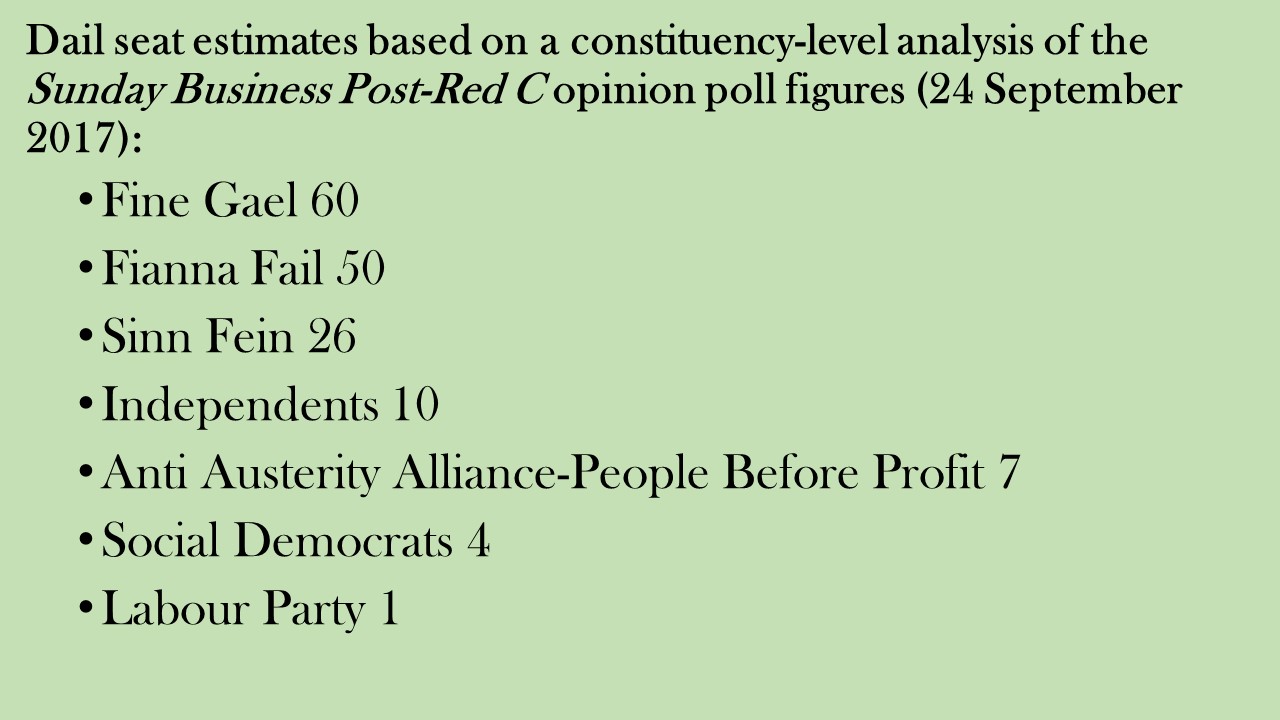
With the exception of the June Ireland Thinks/Daily Mail opinion poll, Fine Gael did not seem to be experiencing an immediate “Leo-leap” in the polls carried out following the change of party leader some months ago. The first few polls carried out just before/at the start of the new Dail term do offer a more attractive scenario for the government party, with gains in support being evident in the latest Sunday Business Post-Red C opinion poll and especially in the recent Sunday Times-Behaviour & Attitudes and Ireland Thinks/Daily Mail opinion polls. All in all, the general trend in polls carried out over the past few months suggest that Fine Gael have made notable gains relative to the low levels of support that were evident for that party in the opinion polls of Winter/early Spring 2017 and that they have now re-established their position as the most popular political party/grouping in the land. Both These trends also suggest that Fianna Fail and Sinn Fein seem likely to be gaining support also, relative the levels won by these parties at the February 2016 election, although support levels for Independents have declined notably since that contest and Labour’s support levels still remain lower than the low levels of support won by them in that contest. Support levels for other smaller/”minor” parties and groupings are harder to glean, with the seat estimates for these parties varying notably from poll to poll (for these parties a 1% gain/decline in national support levels could have a very significant impact on their overall number of seats nationally).

The 24th September 2017 Sunday Business Post-Red C opinion poll estimates party support levels as follows: Fianna Fail 26% (up 2% relative to the previous Red C opinion poll), Fine Gael 30% (up 3%), Sinn Fein 16% (down 2%), Independents and Others 23% (down 2%) – including Solidarity-People Before Profit 4%, Social Democrats 4%, Green Party 2%, Renua 1%, Independents 12% – Labour Party 5% (down 1%). My constituency-level analysis of these poll figures estimates that party seat levels, should such national support trends be replicated in an actual general election, would be as follows: Fianna Fail 50, Fine Gael 60, Sinn Fein 26, Solidarity-People Before Profit 7, Social Democrats 4, Labour Party 1, Independents 10.  

The 25th September 2017 Ireland Thinks/Daily Mail opinion poll estimates party support levels as follows: Fianna Fail 29% (up 3% relative to the previous Ireland Thinks opinion poll), Fine Gael 32% (up 1%), Sinn Fein 14% (down 2%), Independents and Others 23% (NC) – including Solidarity-People Before Profit 2%, Social Democrats 2%, Green Party 3%, Independents 12% – Labour Party 5% (down 2%). My constituency-level analysis of these poll figures estimates that party seat levels, should such national support trends be replicated in an actual general election, would be as follows: Fianna Fail 55, Fine Gael 66, Sinn Fein 19, Labour Party 2, Social Democrats 2, Green Party 1, Solidarity-People Before Profit 1, Independents 12.  

The 17th September 2017 Sunday Times-Behaviour & Attitudes opinion poll estimates party support levels as follows: Fianna Fail 25% (down 5% relative to the previous Behaviour & Attitudes opinion poll), Fine Gael 33% (up 4%), Sinn Fein 19% (up 1%), Independents and Others 23% (up 1%) – including Solidarity-People Before Profit 1%, Social Democrats 1%, Green Party 2%, Independents 13% – Labour Party 5% (NC). My constituency-level analysis of these poll figures estimates that party seat levels, should such national support trends be replicated in an actual general election, would be as follows: Fianna Fail 45, Fine Gael 69, Sinn Fein 31, Labour Party 2, Solidarity-People Before Profit 1, Independents 10.  

Continue reading →

Posted in General Election, opinion polls | Tagged , , , , , , , | 1 Comment

Fine Gael experiencing a “Leo-Leap”?: Constituency-level analysis of the Ireland Thinks/Dail Mail opinion poll (26 June 2017) and other Summer 2017 polls

Adrian Kavanagh, 26th June 2017

IrelandThinksDailyMail_26June2017A

Having experienced a series of poor figures across opinion polls in the earlier months of 2017, the Fine Gael party fortunes did improve somewhat in the polls carried out in March and April. Changes of party leadership, however, often do result in a “bounce” in opinion poll support levels for politician parties and this is what transpires in the Latest in the series of Ireland Thinks/Daily Mail opinion polls, with a six percentage point gain in support levels being recorded by Fine Gael weeks after Leo Varadkar became the new party leader (and was subsequently elected Taoiseach). This poll is perhaps particularly significant as it is the first poll to be published after Leo Varadkar became the new Fine Gael party leader. Out of the other parties/groupings, this also amounts to a good opinion poll for the Labour Party and this poll shows that party on one of its highest support levels out of any of the opinion polls carried out in the wake of the February 2016 General Election. Most of the other parties/groupings – with the exception of the Green Party – do lose ground in this poll, with a four percentage point drop in support levels being recorded for the Independents grouping.   

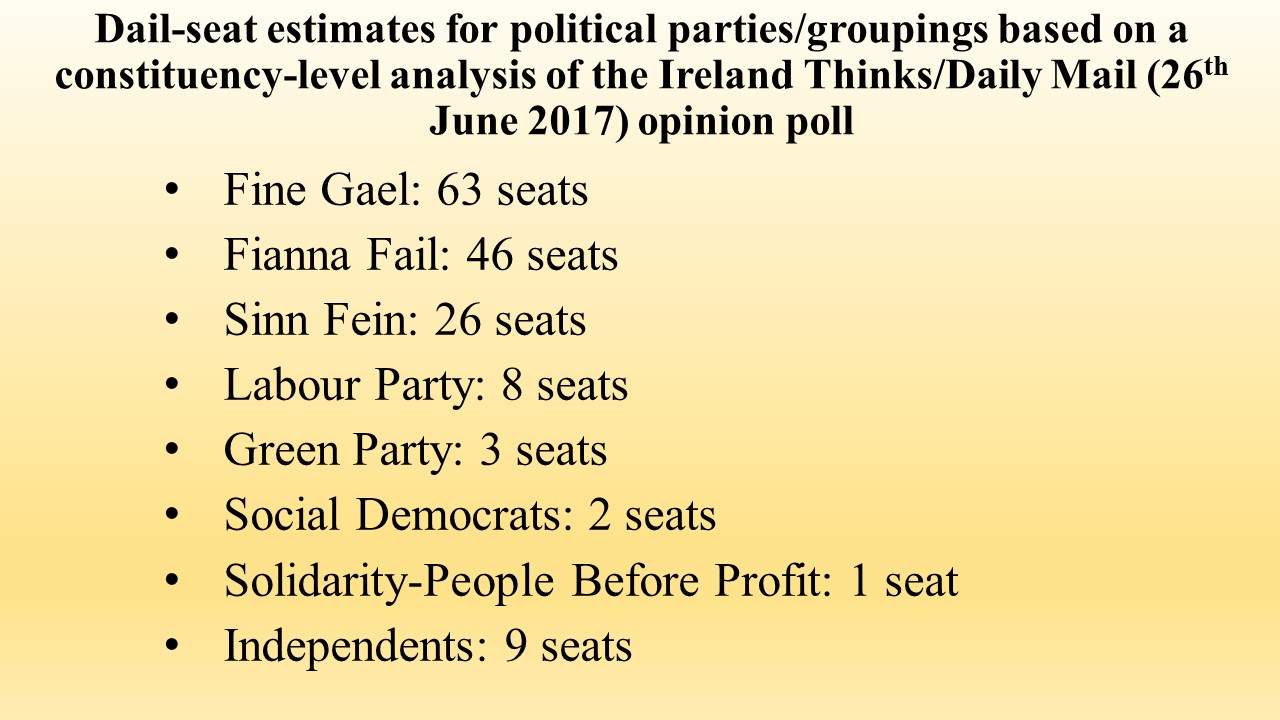
The 26th June Ireland Thinks/Daily Mail opinion poll estimates party support levels as follows: Fianna Fail 26% (down 1% relative to the previous Ireland Thinks/Daily Mail opinion poll), Fine Gael 31% (up 6%), Sinn Fein 16% (down 1%), Independents and Others 19% (down 6%) – including Solidarity-People Before Profit 2%, Social Democrats 2%, Green Party 4%, Independents 11% – Labour Party 7% (up 2%). My constituency-level analysis of these poll figures estimates that party seat levels, should such national support trends be replicated in an actual general election, would be as follows:  Fianna Fail 46, Fine Gael 63, Sinn Fein 26, Labour Party 8, Solidarity-People Before Profit 1, Social Democrats 2, Green Party 3, Independents 9.   Continue reading →

Posted in General Election, opinion polls | Tagged , , , , , , , | Leave a comment